
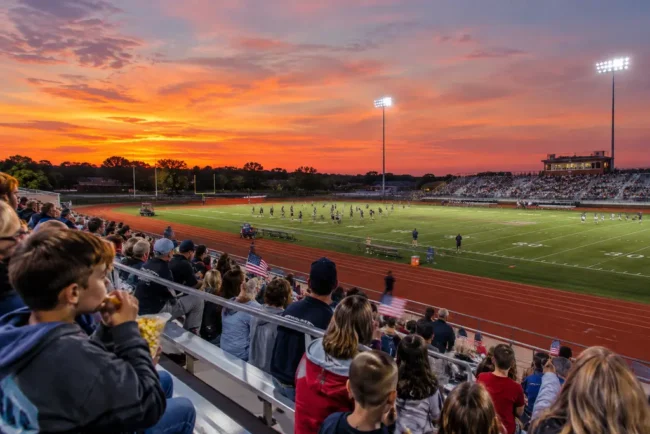
Gene R. Haynes Stadium is best read as both a school-sports correction and a community-infrastructure test. As of October 30, 2026, the venue had not opened; the research record points to a projected fall 2027 completion for the stadium and the replacement Butler-Gast YMCA. That timing matters because the most meaningful outcomes—youth participation, affordable access, daily use, and public-health reach—cannot be measured yet. What can be assessed now is the plan: who is backing it, where it is being built, what it is meant to host, and why Omaha North High School’s first on-campus varsity competition stadium carries unusual practical weight.
Gene R. Haynes Stadium And The Access Gap
Gene R. Haynes Stadium Timeline And Scope
The project sits along the Ames Avenue corridor just east of Omaha North High School, near North 34th and Ames. Omaha Public Schools approved the site and design plans in July 2025, and the project’s public materials say the collaboration among the city, school district, and YMCA was planned so that no homes would be demolished. The broader effort, known as Project Game ON, joins Omaha Public Schools, the YMCA of Greater Omaha, and philanthropic partners, with support that includes Nebraska Department of Economic Development North and South Omaha Recovery Grant funding, according to the Project Game ON FAQs.
The timeline in the research record is clear enough for planning analysis. Project Game ON was publicly announced on April 4, 2025. Site preparation and demolition of the old YMCA were slated for September 2025, with construction beginning after that phase. The opening target for both the stadium and the new YMCA is fall 2027. The combined project is described in the research notes as a $50 million-plus investment, with the YMCA replacement expected to be about 39,000 square feet. The stadium program includes a press box, concessions, restrooms, team rooms, and storage.
Naming Ties Facility To Omaha North Identity
On July 13, 2026, the Omaha Public Schools Board unanimously named the venue for Gene R. Haynes, a longtime Omaha North principal and teacher. The naming honored an educator who served Omaha North for more than 50 years and led the school as principal from 2001 until his 2020 retirement, as reported by WOWT. For a school venue, that context is not cosmetic. Naming can link a building project to a school’s institutional memory, especially where the facility addresses a need that stretched across generations of students and teams.
Omaha North opened in 1924 and, according to the research record, had not had an on-campus varsity competition stadium despite winning multiple state football championships. That gap shaped the meaning of the project. A stadium is not just a place to stage games; it changes the routine of team preparation, student support, campus identity, and game-day logistics. Moving varsity competition onto campus can reduce separation between school life and athletic life, though the long-term participation impact will depend on scheduling, operating costs, and program access after opening.
Program Uses Beyond Varsity Football
School Sports And Daily Community Use
The planned venue is designed for football and soccer, with broader community use included in the project mission. That mix is significant because single-purpose stadiums can sit idle outside varsity schedules, while multi-use school facilities have a better chance of serving youth teams, camps, physical education, and community events. The research also states that the old athletic field will remain for track and field and practice use. If that arrangement holds, Omaha North could gain a competition venue without losing a practice and track asset, a practical point for coaches managing limited field time.
For students, the most direct change is the ability to play true home games on campus. That can affect attendance patterns, band and student-section involvement, and the ease with which families attend after school or work. Still, the evidence available before opening cannot prove that participation will rise. A cautious evaluation should wait for usage schedules, fee policies, transportation plans, and youth-program enrollment data once the facility begins operating.
YMCA Replacement Extends The Facility Mix
The replacement Butler-Gast YMCA is central to the project’s public-health case. The planned YMCA amenities include an indoor pool, gymnasium, exercise spaces, community rooms, and an indoor walking track. Those features matter because youth sports access is not limited to varsity athletes. Pools, gyms, walking tracks, and community rooms can serve younger children, families, seniors, and residents using the building outside school competition windows.
That broader facility mix also changes how the project should be judged. A stadium alone would mainly answer a school-athletics need. A stadium paired with a YMCA can support summer camps, community fitness, youth training, wellness programming, and school championships. A related site in this publishing network, Bass Lake Roadhouse, reflects how local gathering places contribute to community engagement through recreation, even though Omaha’s project is more focused on school and wellness rather than hospitality.
Equity Questions For Youth Sports Infrastructure

Access Depends On Operations
Project materials frame the work around youth development, public health, affordability, and accessibility in North Omaha. Those aims are consistent with a wider facilities issue: construction creates capacity, but operations determine who benefits. The decisive questions after opening will be basic and measurable. How many youth teams receive field time? What are the costs for families? Are summer camps priced within reach? Are walking-track and pool hours convenient for residents? Are community rooms booked by neighborhood groups as well as formal institutions?
Those questions are not unique to Omaha. Similar debates appear across youth facility projects where new construction is expected to widen opportunity but must still manage pricing, staffing, safety, and scheduling. For a broader discussion of those tradeoffs, Ambikapur City’s analysis of community sports facilities and youth access offers a useful comparison point. The Omaha case will be stronger if access policies are visible, repeatable, and tied to local needs rather than left to informal arrangements.
Construction As Education Pipeline
The research also notes that students from Omaha North High and Skinner Elementary are expected to be involved in design and construction processes through job shadowing, presentations, and other learning opportunities. That piece should not be treated as a substitute for long-term sports access, but it adds an educational layer. A public-facing project can introduce students to architecture, construction trades, project management, facility operations, and civic planning.
For a neighborhood sports project, that learning component is useful because it connects the physical build to career exposure. The value will depend on how structured those opportunities are, how many students participate, and whether engagement continues beyond one-time presentations. Without those details, the safest reading is that the project includes a promising education element, not a proven workforce pathway.
- Confirmed site focus: Ames Avenue corridor, east of Omaha North High School.
- Confirmed partners: Omaha Public Schools, YMCA of Greater Omaha, and philanthropic foundations.
- Confirmed venue uses: football, soccer, school events, youth sports, and community programming.
- Confirmed YMCA amenities: indoor pool, gymnasium, exercise spaces, community rooms, and indoor walking track.
- Unproven outcomes: participation gains, affordability in practice, and long-term public-health effects.
Gene R. Haynes Stadium Community Impact
The strongest case for the project is that it addresses a specific facilities gap while adding a broader wellness asset in North Omaha. Omaha North’s lack of an on-campus varsity competition stadium was unusual given the school’s age and football success. Pairing the stadium with a YMCA replacement gives the development a wider base than Friday-night football alone.
The cautious view is that buildings do not automatically create equitable access. Gene R. Haynes Stadium can become a meaningful community asset if its daily schedule supports students, youth clubs, families, and neighborhood programming after the ribbon-cutting. The most useful measures after fall 2027 will be participation levels, hours of community use, affordability policies, camp enrollment, and the balance between school-team needs and public access. Until those results are available, the project should be seen as a well-defined infrastructure investment with clear community goals and outcomes still to be tested.