
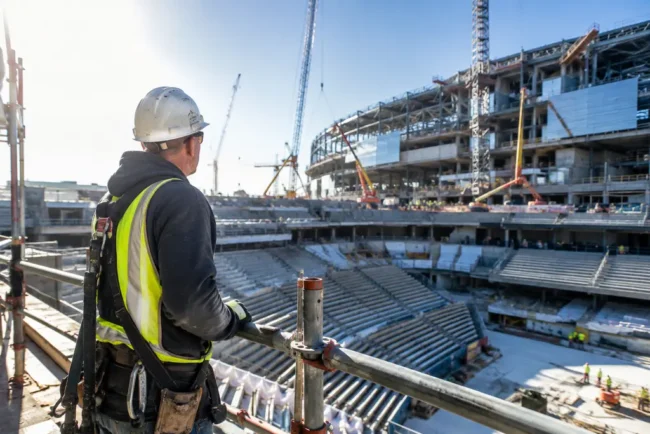
Stadium Renovation Financing at Bank of America Stadium has become a $1.3 billion facilities case for Charlotte, with a projected completion date in 2030 and a public-private split that now stands at roughly half city-backed money and half Tepper Sports & Entertainment funding. As of November 1, 2026, the main question is not whether the stadium will be modernized; it is how the financing structure assigns risk between hospitality taxpayers, the city, and the teams that use the venue.
The figures are now clearer than they were when Charlotte City Council approved the city share on June 24, 2024, by a 7-3 vote. The city commitment remains capped at up to $650 million for mandated improvements and a new field house. Tepper Sports & Entertainment, owner of the Carolina Panthers and Charlotte FC, had an initial $150 million commitment and added $500 million in July 2026, bringing its private contribution to $650 million. The NC Auditor report released on October 28, 2026, reported the $1.3 billion projected renovation cost and the public-private funding split.
How Stadium Renovation Financing Is Shared
Public And Private Shares
The financing plan is unusual less because of the headline public contribution and more because the private share rose after the public approval. The city did not raise its $650 million commitment after the total project cost increased to $1.3 billion. That matters for taxpayer exposure because the city share is fixed to its mandated scope, while Tepper Sports & Entertainment is tied to the added private scope, potential overage costs, and ongoing maintenance obligations under the current agreement.
The most useful way to read Stadium Renovation Financing in Charlotte is as a capped public participation model rather than an open-ended public buildout. That does not erase the size of the city commitment. A $650 million public obligation remains substantial. It does, however, separate the mandated public work from premium areas, new private and club spaces, and optional features that are assigned to Tepper Sports & Entertainment funding under the research record.
| Funding Element | Documented Amount Or Term | Analytical Relevance |
|---|---|---|
| City of Charlotte commitment | Up to $650 million | Funds city-mandated stadium upgrades through public financing. |
| Tepper Sports & Entertainment contribution | $650 million total | Creates an approximate 50/50 split after the July 2026 private increase. |
| Total projected renovation cost | $1.3 billion | Sets the full scale of the Bank of America Stadium modernization plan. |
| Non-relocation term | Through April 1, 2046 | Links city investment to long-term presence of the Panthers and Charlotte FC. |
Stadium Renovation Financing Protections
The main protection for Charlotte is that Tepper Sports & Entertainment is responsible for overage costs and ongoing maintenance obligations tied to the renovation project under the current agreement. In stadium finance, that distinction is meaningful because construction costs can rise as designs move from renderings to contracts. The protection is not the same as eliminating public cost; it limits the city’s exposure beyond the agreed scope.
The non-relocation clause also has sports value. The Panthers and Charlotte FC must remain in the stadium through April 1, 2046, in exchange for the city’s $650 million investment. For a city using tourism-related tax revenue on a major venue, that term is part of the return framework: the facility keeps NFL and MLS dates anchored downtown, while the teams receive upgraded infrastructure for game operations and revenue-producing spaces.
Tax Sources And Public Exposure
Hospitality Taxes Carry The Debt
The public side is being financed with $650 million in Special Obligation Bonds. The North Carolina Local Government Commission approved that financing on April 1, 2026. The North Carolina Treasurer release stated that debt service will be paid through Mecklenburg County occupancy tax revenue and prepared food and beverage tax revenue.
That source of repayment narrows the burden compared with a broad property-tax-backed plan, but it does not make the cost invisible. Hotel and short-term rental guests are part of the occupancy tax base. Restaurant, catering, and prepared food customers are part of the prepared food and beverage tax base. Some of those customers are visitors, and some are local residents. The taxpayer impact is therefore tied to how much Charlotte’s hospitality economy produces during the repayment period.
The research record also states that these revenues are legally restricted to hospitality and tourism purposes, including the convention center, tourism promotion, amateur sports facilities, and stadiums seating more than 60,000. Bank of America Stadium qualifies. That restriction is central to the city’s argument for using these revenues, but it also creates an opportunity-cost question: money assigned to the stadium is money not available for other permitted hospitality and sports uses.
Early Spending Was Limited
As of August 2026, Charlotte had disbursed $3.1 million of its $650 million commitment. About $2.5 million went toward construction, largely work on the Panthers Field House, and about $632,656 went toward financing and borrowing costs. The early spending pattern shows that the largest taxpayer exposure was still ahead as of the latest documented spending point, not already paid out in full.
For the fiscal year ending June 2027, the city budgeted $33 million from the occupancy tax and $56.8 million from the prepared food and beverage tax toward debt service and other public hospitality projects. Those figures show the scale of the revenue stream, but they do not by themselves prove how comfortably the full debt will be handled over time. Debt coverage will depend on collections, debt terms, and competing eligible uses within the restricted revenue categories.
Facility Scope And Community Trade-Offs
What Fans And Teams Receive
The renovation scope covers both visible fan-facing work and less visible building systems. Documented elements include new seating, modernized lighting and video systems, aesthetic upgrades, restrooms, fan zones, mechanical systems, electrical systems, plumbing systems, elevators, and safety and security improvements. Those categories are typical of a stadium that is trying to extend its useful life without replacing the building entirely.
For game-day users, the practical value sits in basics as much as premium features. Restroom capacity, vertical movement, seating condition, lighting, and video boards all affect how a venue functions during NFL and MLS events. For a broader venue operations frame, the site’s analysis of stadium amenities planning shows why teams increasingly treat circulation, food service, and premium areas as long-range facility questions rather than cosmetic upgrades.
Community Sports Questions
The community trade-off is more difficult to measure. Bank of America Stadium hosts major professional sports, but the tax sources used for debt service sit inside a restricted bucket that can also support amateur sports facilities. That does not mean youth or community sports lose a specific project because of this renovation; the research does not document such a one-for-one displacement. It does mean public officials should keep reporting how stadium debt service interacts with other eligible sports and tourism needs.
Venue operators across sports, including smaller golf and recreation properties such as Copeland Hills Golf, face a basic facilities question: which upgrades serve daily users, which serve premium revenue, and which require public support. Bank of America Stadium is far larger and publicly significant, but the underlying test is similar. Public money is easier to defend when the funded work is tied to long-term infrastructure, safety, accessibility, and broad use rather than narrow private benefit.
Oversight Milestones Through 2030

Quarterly Reporting Matters
Oversight is a key part of the Charlotte structure. The North Carolina Office of the State Auditor is providing ongoing reporting, with updates at least quarterly, to track borrowing, disbursements, project progress, and public benefits. The first report, PER-2026-7041, was released on October 28, 2026. Because the project is expected to run to 2030, these updates should give residents and policymakers a recurring record rather than a single approval vote followed by limited public visibility.
The reporting should be judged on several practical measures: whether bond proceeds are spent within the approved scope, whether disbursements match construction progress, whether private obligations remain separate from city-funded work, and whether public benefits are described in measurable terms. The strongest public finance structure can still lose credibility if spending categories are hard to follow or if cost responsibility becomes blurred.
What Remains Uncertain
Several important points remain uncertain from the documented record available on November 1, 2026. The research does not provide final debt service totals over the full repayment period, final construction contracts for every package, or a completed cost-benefit accounting of the project’s public return. It also does not prove how hospitality tax collections will perform through 2030 and beyond. Those gaps are not unusual at this stage, but they are the areas where future public reporting will matter most.
The financing plan does contain clearer boundaries than many older stadium deals: a fixed city contribution, a matching private contribution, overage obligations assigned to Tepper Sports & Entertainment, maintenance responsibilities, and a non-relocation term through 2046. Still, the city is taking on a large public debt obligation backed by taxes paid through hospitality activity. That combination calls for steady review rather than one-time acceptance.
Bank Of America Stadium Renovation Financing
This Stadium Renovation Financing model gives Charlotte modernized facilities without placing the entire $1.3 billion project on public accounts. That is the strongest point in its favor. The $650 million private share, the overage commitment, and the maintenance obligation reduce the chance that the city’s capped participation becomes a full project backstop.
The public burden remains significant. Restaurant customers, hotel guests, and short-term rental users will support debt repayment through taxes tied to the hospitality economy. The most balanced reading is that Charlotte secured meaningful private participation and team-location commitments, while still accepting a major public obligation for a privately operated professional sports venue. Through 2030, the quality of oversight will determine whether that balance holds in practice.