

World Cup Fever Has Reached the Dusty Corners Too
Every four years, football performs its favorite magic trick. It makes people who normally argue about cricket strike rates suddenly discuss formations, pressing lines, penalty nerves, and whether a left-footed winger is “inverted” or just allergic to crossing early.
In Ambikapur, that fever does not stay inside television screens. It spills onto the local grounds, into evening practice sessions, and onto the muddy patches where young players try to recreate World Cup goals with a ball that has survived more tackles than some professional defenders.
That is where Sendhopara enters the story.
Ambikapur’s grassroots football scene may not have the floodlights of MetLife Stadium or the historic gravity of Estadio Azteca, but it has something the global game still depends on: raw participation. Before the World Cup becomes a 104-match commercial spectacle, it begins with children chasing a ball, coaches repeating the same drill for the fiftieth time, and local grounds becoming unofficial academies.
The 2026 FIFA World Cup, hosted by Canada, Mexico, and the United States from June 11 to July 19, is the biggest edition in tournament history. It features 48 teams instead of 32, a new Round of 32, and 104 matches across 16 host cities. That expansion is not just trivia for quiz night. It is football’s global message in bold font: the game is widening its doors.
For Ambikapur, the lesson is obvious. The World Cup is not only something to watch. It is something to study.
The Global Game Is Getting Bigger, But The Basics Still Start Small
The expanded World Cup tells one clear story: football wants more countries, more players, more audiences, and more pathways. More nations now have a realistic shot at qualifying, which means more local federations must invest in scouting, coaching, player fitness, and youth systems.
That should matter to Ambikapur because grassroots football survives on the same logic, only at a smaller scale. If the global game is widening access, local football cannot remain dependent on random talent, occasional tournaments, and the heroic patience of coaches who somehow turn half-pitches into classrooms.
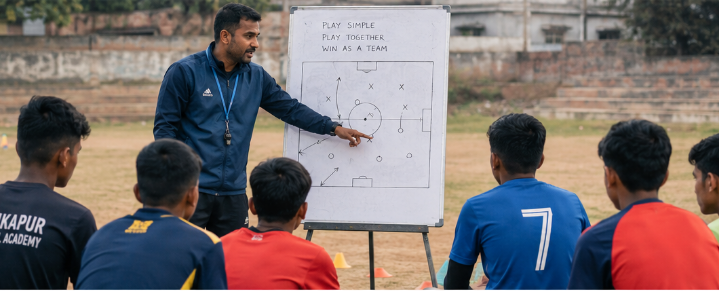
The All India Football Federation’s Blue Cubs program offers a useful national reference point. It focuses on children aged 4 to 12 and promotes age-appropriate formats such as 2v2, 3v3, 5v5, and 7v7. That may sound simple, but it is exactly the kind of thinking local football needs. Children do not need to be thrown into full-size chaos immediately. They need more touches, more decisions, more confidence, and fewer adults shouting tactical poetry from the sideline.
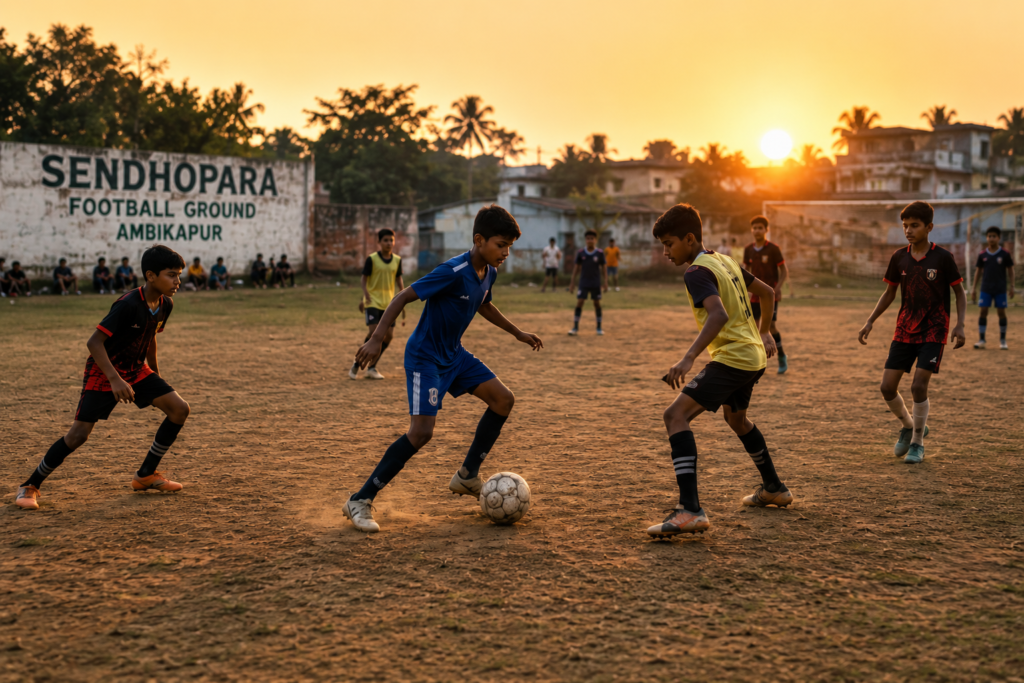
For readers who already follow local football culture through Ambikapur football grounds, the World Cup lens makes the same local spaces look different. Sendhopara is not just a place where boys gather after school. It can become a miniature version of the football pipeline: first touch, first team, first local rivalry, first real lesson in losing without pretending the referee has a family conspiracy against you.
What Sendhopara Can Learn From World Cup Teams
World Cup teams do not win because eleven talented players meet in the tunnel and hope vibes will carry them to the final. They win because of structure. Argentina’s 2022 title under Lionel Scaloni was not just about Lionel Messi’s genius; it was about tactical balance, emotional control, squad roles, and the ability to survive pressure. Morocco’s 2022 semifinal run under Walid Regragui showed another lesson: organization can turn outsiders into nightmares.
That matters for Ambikapur because grassroots football often celebrates flair before structure. The kid who dribbles past four players gets applause. The defender who closes space early, communicates well, and prevents danger before it becomes drama gets ignored like a terms-and-conditions checkbox.
World Cup football teaches that the invisible work wins matches.
| World Cup Lesson | What It Means For Ambikapur Grassroots Football |
|---|---|
| Squad roles matter | Local teams need defined defenders, midfielders, forwards, and rotating substitutes instead of everyone chasing the same ball, as it owes them money |
| Fitness wins late games | Evening practice should include stamina, sprint recovery, and warm-down routines, not just endless shooting |
| Small-sided games develop intelligence | Young players learn faster in 5v5 and 7v7 formats because they touch the ball more often |
| Tactical discipline beats chaos | Coaches should teach pressing, spacing, and transitions in simple language |
| Tournament pressure is trainable | Local leagues should include knockout-style games, penalties, and timed scenarios |
This is where Sendhopara and other Ambikapur grounds can quietly improve. Not with expensive speeches. Not with imported jargon. With better training habits.
A 12-year-old who learns to scan before receiving the ball is already ahead. A local defender who understands body position is not just “clearing it somehow”; he is reading the game. A goalkeeper who practices distribution instead of only shot-stopping becomes part of the attack. These are World Cup ideas, yes, but they do not require a World Cup budget.
Coaching Must Move Beyond Talent Spotting
Grassroots football often treats coaching like treasure hunting. Find the naturally gifted player, polish him a little, and hope he becomes the story. That approach is romantic, but it wastes too many players.
Modern football development is less about discovering one miracle child and more about building systems where many players improve. That is why age-group formats, regular fixtures, basic sports science, and coach education matter. Talent is not a lottery ticket; it is a long-term maintenance project.
Ambikapur’s coaches can borrow three habits from elite football environments:
- Track progress through simple metrics: attendance, stamina, passing accuracy, weak-foot use, and match discipline.
- Separate training by age and ability where possible, so beginners are not crushed, and advanced players are not bored.
- Build a seasonal calendar with practice blocks, friendly matches, recovery weeks, and local tournaments.
This does not make the game less fun. It makes fun more productive.
The best World Cup teams are not built in the month before the tournament. They are built through years of player development, tactical identity, and competitive exposure. Ambikapur does not need to copy Europe or South America blindly. It needs to adapt the principle: make improvement repeatable.
Why Local Leagues Matter More Than One Big Tournament
A single tournament can create excitement. A league creates football culture.
This is one of the biggest lessons Ambikapur can take from the global game. The World Cup is glamorous because it sits on top of thousands of clubs, academies, leagues, qualifiers, and scouting networks. The tournament is the fireworks. The system is the fuse.
Local football needs more regular competition. Not just a once-a-year event where every team arrives underprepared, plays three emotional matches, and disappears until the next poster is printed. Young players need repeated match situations. Coaches need to see how players respond across weeks, not one lucky Sunday.
| Local Football Need | Practical Ambikapur Solution |
| More match experience | Monthly youth fixtures between neighborhood teams and school groups |
| Better player tracking | Simple scorecards for attendance, position, goals, assists, discipline, and improvement |
| Safer development | Age-group games with shorter match duration and proper hydration breaks |
| Stronger community support | Local volunteers manage fixtures, basic ground discipline, and parent coordination |
| Better transition to senior football | U12, U15, U18, and open-age divisions feeding into local clubs |
This is where World Cup fever can be useful if Ambikapur treats it as motivation rather than background noise. When children watch Kylian Mbappé sprint behind a defensive line or Jude Bellingham control midfield tempo, coaches can turn those moments into teaching points. Not every child will become a professional, obviously. But every child can learn movement, teamwork, discipline, and decision-making.
That is already a victory.
The Business Side Of World Cup Fever Has A Local Lesson Too
The World Cup is now a global football event, media event, tourism event, and sports-business event at the same time. Around the tournament, broadcasters plan months, brands compete for attention, and fan behavior changes dramatically. Even industries around the game prepare for the surge, as seen in this analysis of World Cup sportsbook trends.
Ambikapur’s local football scene can learn from that preparation mindset without copying the commercial excess. Planning matters. Communication matters. Fixtures, posters, registration, volunteer roles, water arrangements, referee availability, and basic medical support should not be decided five minutes before kickoff while someone is still searching for the whistle.
If a World Cup host city plans fan movement, security, pitch standards, and broadcast logistics, a local Ambikapur tournament can at least plan match timings, drinking water, team lists, and first-aid access. Scale changes. Responsibility does not.
Ambikapur’s Football Future Needs More Than Passion
Passion is Ambikapur football’s cheapest and most available fuel. It is also not enough.
The city needs better scheduling, safer grounds, more structured youth sessions, and community support that goes beyond clapping when someone scores from distance. Parents need to see football as a developmental space, not just an evening distraction. Schools need to treat organized football as a pathway for fitness and confidence. Local clubs need to create clearer roles for coaches, volunteers, senior players, and younger squads.
The World Cup offers Ambikapur a useful mirror. At the highest level, football is not random. It is planned, measured, repeated, and refined. The magic still exists, but it is built on boring things done well: warm-ups, passing lanes, recovery, spacing, communication, and patience.
Sendhopara may be far from New York, New Jersey, Mexico City, Toronto, or Los Angeles, but the same ball still rolls by the same laws. Control it. Pass it. Move again. Defend together. Think before the tackle. Respect the whistle, even when the whistle appears to have made a deeply personal mistake.
That is the real bridge from Ambikapur to the World Cup. Not pretending a neighborhood ground is a global stadium, but understanding that every football nation, every famous academy, and every World Cup star once began somewhere small.
For Ambikapur, that somewhere can be Sendhopara.