
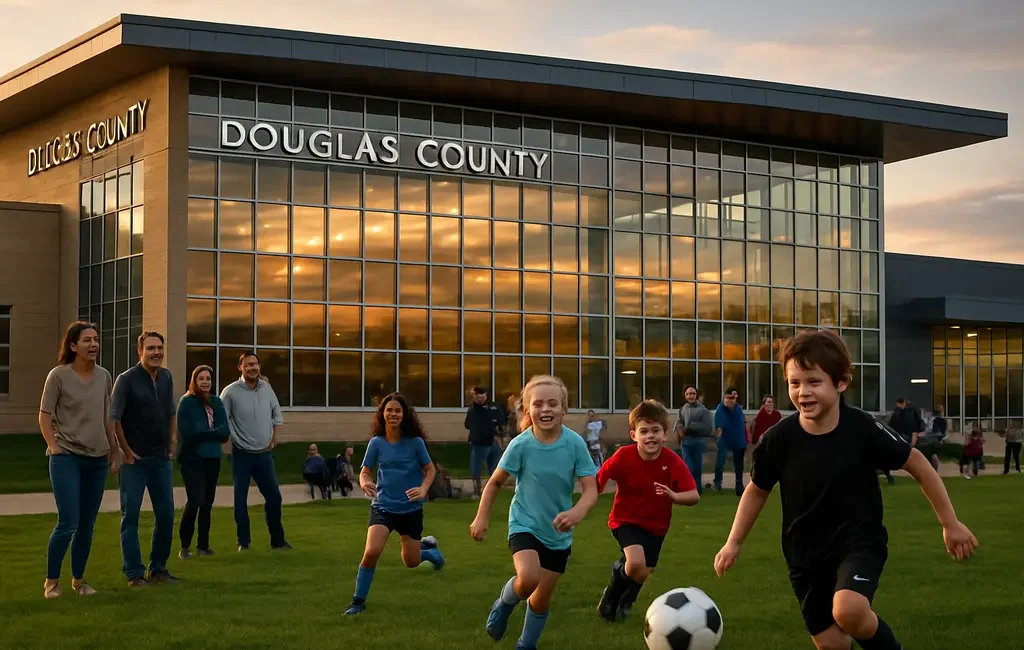
Douglas County Sports Facilities are moving from planning into a sharper delivery phase, with two major projects shaping the county’s youth sports strategy: the proposed Zebulon Regional Sports Complex in northern Douglas County and the planned Gold Crown Field House in Castle Rock. The public case for both projects rests on access, year-round participation, and partnership funding rather than on a single team, league, or tournament. As of September 8, 2026, the strongest analysis is still cautious: the project scale is clear, several funding actions have already happened, but the full community value will depend on pricing, scheduling, coaching access, and operating discipline once the venues open.
Douglas County Sports Facilities: Confirmed Project Scale
The county’s youth sports plan is not based on one building type. It combines ice, court, turf, diamond, and fitness space, which matters for club managers because each sport has different peak-hour pressure, coaching requirements, and season length. A facility that can serve multiple sports can reduce off-season gaps, but only if prime slots are not captured entirely by high-fee events or narrow travel-program blocks.
Zebulon Regional Sports Complex
The proposed Zebulon Regional Sports Complex is planned on 46.5 acres in northern Douglas County. Its intended mix includes three full NHL-sized hockey rinks, a practice ice rink, eight full multi-sport courts, a sports dome with indoor turf and a removable roof, baseball and softball fields, and a 15,000-square-foot fitness and lifestyle center. Douglas County reported that the estimated total cost, including site development and utilities, is $100 million; KT Development was awarded a contract on March 31, 2026, to design, build, program, operate, and maintain the complex; and the county planned Certificates of Participation of up to $100 million, which do not raise taxes, according to Douglas County’s project notice.
The financing detail is central to judging public benefit. The reported $65 million figure covers KT Development’s price for building the facilities, excluding utilities and broader infrastructure, while about $34 million is expected from private partner contributions. Site infrastructure plans covering grading, water, sewer, drainage, and road improvements were approved by the Douglas County Planning Commission on February 2, 2026. The land path also moved before the construction contract: on October 14, 2025, Douglas County acquired 46.5 acres from Sterling Ranch through a transaction involving 34.2 acres plus existing county land, while Sterling Ranch received 23.8 acres in return for commercial development rights.
Gold Crown Field House In Castle Rock
The Gold Crown Field House is a separate planned indoor project in Castle Rock’s Dawson Trails development. It is planned as a 75,000-square-foot facility on 22 acres through a partnership among Douglas County, the Town of Castle Rock, and the nonprofit Gold Crown Foundation. Douglas County approved a $7.5 million funding agreement on August 4, 2026; Castle Rock is contributing land valued at about $10 million; Gold Crown has committed $5 million plus private donations; and the project still had a reported funding gap of about $11.7 million, with further fundraising expected to reduce it to about $2.7 million, according to the Denver Gazette report.
The same report placed the planned groundbreaking in April 2027, followed by about 12 months of construction and a target opening in early 2028. It also reported expected annual usage of about 15,000 youth participants and 500,000 to 600,000 visitors once operational. Those projections are significant for sports tourism and local club scheduling, but they should be treated as operating targets until the field house is open and annual use data can be checked against actual registrations, event calendars, and facility reports.
Funding And Operating Model
Douglas County Sports Facilities have been tied to a broader recreation funding structure rather than a one-time venue push. The voter-approved Parks, Trails, Historic Resources and Open Space Fund, renewed in 2022, is expected to generate more than $330 million over 15 years through a sales tax measure. That gives the county a long funding runway, but it also raises a basic accountability question: how much of the benefit reaches everyday youth teams compared with tournaments, rentals, and adult programming?
Voter Funding And Private Partners
The Zebulon operating model is designed to be self-sustaining, with operating revenue intended to cover ongoing costs and repay the county’s investment. That model can work only if demand is deep enough across ice, court, turf, baseball, softball, fitness, camps, and events. For coaches and club boards, the key issue is not simply whether a building exists. It is whether the operating plan protects enough affordable hours for introductory programs, recreation leagues, and developmental teams.
The Gold Crown project uses a different partnership frame because it includes the nonprofit Gold Crown Foundation and land support from Castle Rock. That can help align programming with youth participation goals, but the reported funding gap means the project remains exposed to fundraising and cost-control pressure. A related analysis of the Douglas County recreation investment model explains why partnership structures should be measured against usage data, not only construction milestones.
What Coaches And Clubs Should Track
For club management, the most useful measures will be practical. Facility access should be assessed by sport, age group, residency status, time of day, and cost per session. A county can build a large venue and still miss the youth-development target if weekday late-afternoon slots become too costly or if beginner programs are pushed into inconvenient times. Coaches should also watch whether indoor turf and court space support training during weather-affected months without forcing families into long travel patterns.
Community Engagement And Youth Access
The planning record described strong public engagement through live town halls, surveys, and stakeholder feedback sessions in 2024 and early 2025. A town hall on June 27, 2024, focused on Parks, Trails, Historic Resources and Open Space priorities, and youth sports facility needs were identified as a dominant theme. That sequence matters because it connects capital spending to a stated community demand rather than to a venue concept developed in isolation.
Douglas County Sports Facilities In The Community Feedback Process
Douglas County Sports Facilities will be judged by whether that feedback continues after construction decisions. Early engagement can identify need, but post-opening engagement tests whether the answer was accurate. Families may support more ice or court inventory in planning meetings, then face different barriers once fee schedules, travel distance, registration windows, and team allocations are released. For readers comparing how community resources are organized across local networks, related community listings can help place sports venues among other public-facing assets.
The county and operators can make the engagement model stronger by publishing clear, repeatable indicators. Useful measures include:
- Resident and non-resident fee schedules for youth programs.
- Prime-time hour allocations by sport and age group.
- Scholarship or reduced-fee participation totals, if offered.
- Annual youth participant counts compared with projected targets.
- Maintenance spending and reserve planning for long-term facility quality.
- Coach education, safety rules, and field or court assignment standards.
These measures are not minor details. They decide whether a new venue becomes a development pathway or mainly an events asset. In youth sport, the gap between a public access promise and a usable family schedule can be wide, especially for households balancing school, work, transportation, and sibling activities.
Sports Development Impact

Douglas County Sports Facilities could change the county’s sport-development pattern by reducing the need to leave the area for consistent indoor training. Ice sports often face limited sheet availability. Basketball, volleyball, futsal, and other court sports compete for gym time. Baseball and softball programs lose training continuity during poor weather. A combined venue plan can ease those constraints if operators coordinate calendars across school, club, recreation, and tournament demand.
Facility Mix And Club Pathways
The Zebulon mix is especially relevant because it links ice, courts, turf, and diamonds on one regional site. That can support multi-sport youth development, shared strength and fitness programming, and more predictable off-season training. From a coaching standpoint, the risk is overspecialization if access is dominated by single-sport year-round programs. A healthier model would leave room for introductory sessions, short skill blocks, recreational leagues, and sport sampling for younger athletes.
The Gold Crown Field House has a different role because its projected annual youth participation is tied to a nonprofit sports model and a large indoor footprint. If the facility reaches the reported 15,000 youth participants per year after opening, it could become a major player in south-metro youth basketball, volleyball, and related court programming. Still, the final value will be shown through actual participation data after early 2028, not by the planning estimate alone.
Douglas County Sports Facilities As A Community Test Case
Douglas County Sports Facilities offer a useful test case for community engagement because the county has paired voter-backed funding, public land decisions, private and nonprofit partners, and stated operating expectations. The model has strengths: multi-sport planning, year-round indoor capacity, public feedback, and a funding structure that does not rely only on one organization. It also has clear pressure points: a large Zebulon capital plan, a Gold Crown fundraising gap, future construction timelines, and the need to prove affordability after opening.
For families, coaches, and club leaders, the next phase should be less about excitement and more about evidence. The right questions are specific: who gets the peak hours, what fees are charged, how many beginner athletes are served, how scholarships or access supports are tracked, and whether annual reports compare projections with real use. If those answers are public and consistent, Douglas County’s approach could become a practical community sports model. If not, the projects may still add capacity, but the access case will remain partly unproven until operations data confirms it.