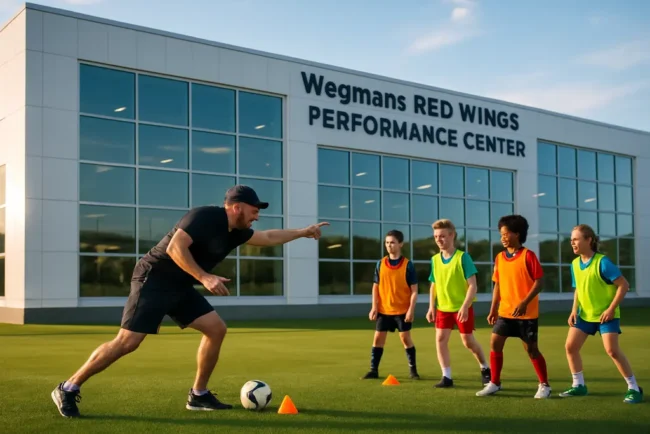
Performance Programming at the Wegmans Red Wings Performance Center has shifted the facility from a player-development asset into a broader community sports platform. The center, located inside ESL Ballpark, was formally named through the Rochester Red Wings and Wegmans partnership announced on April 13, 2026, with the stated intent of serving professional baseball and the Rochester community as an off-season training facility, according to the Red Wings announcement.
That distinction matters for club management and grassroots development. A professional-grade indoor space can be evaluated not only by the quality of its technology, but by how often community members can use it, how programs are structured by age group, and whether access extends beyond the most competitive youth players. The available details show a facility trying to serve multiple participation layers: youth baseball, youth softball, adult recreation, senior softball, and community events.
Performance Programming And Facility Context
Performance Programming As Access, Not Just Training
The Wegmans Red Wings Performance Center opened in March 2025 and includes two HitTrax batting cages, pitching mounds, a strength-and-conditioning room, and player-development tools used by the Red Wings and Washington Nationals. In community terms, the key question is whether that infrastructure remains limited to elite use or becomes part of a year-round local participation model.
Performance Programming appears to answer that question through structured access. The 2026-27 off-season plan included two Free Community Hitting Days: Sunday, October 4, 2026, and Saturday, February 13, 2027. As of October 14, 2026, the October 4 session had already taken place, while the February 13 date remained scheduled. The format offered complimentary 40-minute sessions, giving players of all ages an entry point into HitTrax simulation, analytics, and professional equipment without first committing to a league.
What The Facility Adds To Local Development
The facility’s value is not just indoor batting time. HitTrax simulation, analytics, pitching machines, bat-speed tools, plyometric tools, and personalized reports can help coaches and players connect practice outcomes with measurable feedback. For youth coaches, that can create better conversations around swing decisions, contact quality, and repeatable training habits. For club managers, it gives a way to run sessions with more structure than open cage rental.
The caution is that technology alone does not guarantee better development. Data is useful when coaches explain it clearly and set age-appropriate goals. A young player who sees exit velocity or simulated outcomes without context may chase numbers rather than build skill. The stronger community model is one where technology supports instruction, not where the device becomes the program.
Off-Season Programming Across Age Groups
Youth Baseball And Softball Pathways
The 2026-27 off-season schedule expanded youth baseball options. Youth Baseball Hitting League dates were listed for October 3, 10, 17, 24, and 31, 2026. By October 14, the October 3 and October 10 dates had already passed, while October 17, 24, and 31 remained scheduled. A Mini hitting league was listed for November 2026, holiday leagues for December 2026, and winter hitting leagues starting in January 2027. Softball hitting leagues were also added for winter 2027.
From a grassroots lens, the spread of dates is meaningful because it supports continuity. One-off clinics can introduce players to a facility, but repeated league sessions are better suited to habit formation. Coaches can track changes over several weeks, players get familiar with the environment, and families receive a clearer calendar for off-season development. Performance Programming is most valuable when it reduces seasonal drop-off and keeps athletes engaged during colder months.
Adult And Senior Participation
The adult programming also broadened the audience. Adult Baseball and Softball Hitting Leagues were added for the same off-season cycle. Adult baseball hitting was scheduled on November 3, 10, 17, and 24, 2026, with a winter session listed for January 2027. This matters because community facilities often focus heavily on youth pathways while adult recreational players are left with fewer structured training options.
The most distinctive addition is the Legends Softball Club for senior softball players aged 65 and older. Fall sessions were scheduled on Fridays from November 6 through December 18, 2026, and winter sessions on Mondays from January 4 through February 22, 2027, according to the Legends Softball Club post. For local sports administrators, this is a clear example of programming that treats older athletes as active participants rather than spectators.
| Program Area | Verified Timing | Community Engagement Value |
|---|---|---|
| Free Community Hitting Days | October 4, 2026, and February 13, 2027 | Low-barrier access to technology and equipment |
| Youth Baseball Hitting League | October 3, 10, 17, 24, and 31, 2026 | Repeated off-season practice structure |
| Adult Baseball Hitting | November 3, 10, 17, and 24, 2026 | Organized training for recreational adult athletes |
| Legends Softball Club | November 6-December 18, 2026; January 4-February 22, 2027 | Senior participation and social connection through softball |
Community Engagement And Club Management Impact
Why Free Access Matters
Free entry points are central to the community case. The cost of indoor training and advanced baseball tools can limit access for families, especially if athletes need repeated sessions to benefit. A free 40-minute trial does not solve every access issue, but it can lower the first barrier: unfamiliarity. Players and parents can see the facility, test the equipment, and decide whether a league or future session fits their needs.
For clubs, schools, and community partners, the model also creates a possible bridge between casual participation and organized training. A player may start with a free hitting day, move into a youth league, and later use the facility for more focused off-season work. That pathway is especially useful if coaches coordinate goals rather than treating each program as a separate product.
Operational Questions To Track
The available information supports a positive reading, but some performance measures were not provided in the research. Participation numbers, repeat registration rates, scholarship availability, coach-to-player ratios, and neighborhood reach would help evaluate whether Performance Programming is broadening access or mainly serving athletes who were already connected to baseball and softball training.
- Participation mix: Track age groups, first-time users, and softball-baseball balance.
- Retention: Compare one-day users with athletes who enter multi-week leagues.
- Access: Identify whether free programs reach families outside existing travel and club networks.
- Instruction quality: Review whether analytics are paired with clear coaching feedback.
Those measures would also help nonprofits and youth sports organizations judge partnership value. The Red Wings’ community commitments include support for local nonprofits, youth sports organizations, and hunger-relief efforts tied to the center’s initiatives. For community-sport initiatives connected by similar goals, AP Levante provides another perspective on how local sports projects can align with access and participation objectives.
Wegmans Red Wings Performance Center Community Impact
The strongest argument for the Wegmans Red Wings Performance Center is that it connects professional infrastructure with community use across a full off-season calendar. The center is not only offering cages and equipment; it is segmenting programs for youth athletes, adults, and seniors. That structure is important because community engagement in sport depends on repeatable opportunities, not isolated announcements.
Performance Programming should be judged by practical outcomes: how many people use the facility, whether participation spans different ages and skill levels, and whether coaches convert analytics into better learning. Based on the verified programming dates and facility features, the Red Wings have created a credible framework for broader baseball and softball access in Rochester. The next evidence needed is participation data, because that will show whether the model is reaching the wider community it was designed to serve.