
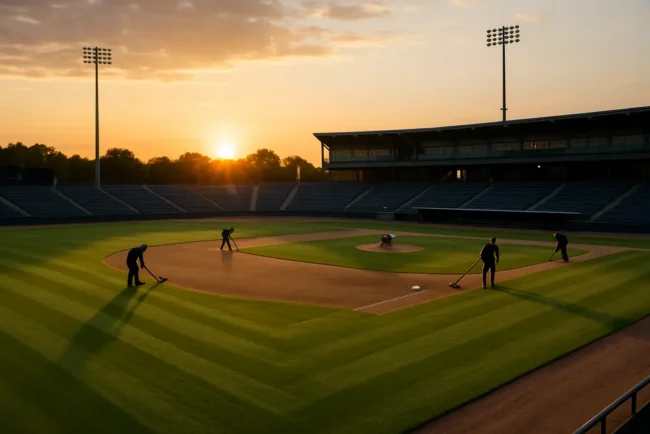
Nymeo Field Renovations gave the Frederick Keys a facility reset that was less about adding spectacle and more about meeting modern baseball operating standards. The $39.1 million project broke ground on May 14, 2025, and construction was completed in May 2026. By October 13, 2026, the stadium had already moved from construction story to operational case study: a local ballpark upgraded for player development, fan circulation, and year-round community baseball use.
What Nymeo Field Renovations Changed
The City of Frederick described the project as a move to bring Nymeo Field at Harry Grove Stadium up to Major League Baseball Professional Development League standards. The scope included new home and visiting clubhouses, modern batting cages, improved bullpens, an expanded concourse, added fan seating, and upgrades tied to player development and spectator use, according to the City of Frederick renovation page.
Nymeo Field Renovations And PDL Standards
The PDL compliance angle matters because modern affiliated baseball places heavier demands on space, recovery, training flow, and clubhouse function than older municipal stadiums were built to handle. A club can have loyal local support and still fall short if batting areas, bullpens, clubhouses, and back-of-house spaces do not meet league requirements. In that sense, the renovation should be judged first as infrastructure protection for professional baseball in Frederick.
The project budget of $39.1 million was shared among the City of Frederick, the Maryland Stadium Authority, and minor league baseball stakeholders. That funding structure is notable because it spreads facility responsibility across public and baseball-linked partners rather than placing the full burden on one side. For a community club, that type of shared commitment can reduce the risk that stadium condition becomes a barrier to keeping higher-level baseball activity in town.
Clubhouse And Bullpen Function
Home and visiting clubhouses are not cosmetic features in a professional development setting. They shape daily preparation, staff workflow, recovery routines, and the practical separation of teams during long homestands. Improved bullpens and batting cages also support more structured work before games and during player development blocks. For coaches, the most useful upgrades are often the ones fans notice least: predictable space, shorter movement between training zones, and facilities that allow staff to run repeatable sessions.
If you’re exploring sports infrastructure across related sites, WikiApp serves as a helpful reference with broader civic and community insights.
Player Development Gains At Harry Grove
The clearest baseball development addition was the IBEW Local 24 Performance Center. The 10,000 square-foot indoor facility opened in June 2026 beyond right field and includes artificial turf, full netting, HitTrax systems, and climate control, according to the Frederick Keys announcement.
Indoor Training And Daily Work
For a coaching staff, indoor space changes scheduling more than branding. Climate control makes winter work, rain-day sessions, and early hitting blocks more dependable. Full netting supports batting practice and throwing drills without the same weather exposure. HitTrax systems can give hitters and coaches measurable feedback during cage work, though the value depends on how consistently coaches use that information in player plans.
Nymeo Field Renovations should be read through that lens: not every upgrade creates an immediate performance gain, but several create better conditions for repetition. Baseball development is built through volume, feedback, and physical readiness. Indoor turf and netted space do not replace field work, yet they help protect training days that would otherwise be lost or shortened.
Grassroots Access Questions
From a community development perspective, the most useful question is whether the renovated facility can serve more than the professional roster. The research notes identify year-round training capacity, which is relevant for youth programs, amateur teams, clinics, and off-season skill sessions if access policies permit it. A related analysis of youth baseball access in Frederick examined how facility improvements can support amateur development when scheduling, cost, and coaching availability line up.
That point needs caution. A better building does not automatically produce broader access. Community impact depends on calendar availability, pricing, transportation, and whether local coaches can connect young players to structured training. The facility now gives Frederick more usable baseball space; the next measure is how often that space supports players outside the professional matchday operation.
Fan And Community Impact In Frederick

For fans, the renovation focused on comfort and movement rather than a simple capacity story. The research notes indicate that upgrades included an expanded concourse and added fan seating, while the larger project centered on amenities and standards compliance. That distinction matters because minor league attendance is often shaped by repeat visits, group outings, and families who judge the night as a whole, not just the final score.
Seating Was Not The Main Story
The renovation did not need to be judged mainly by whether the park became larger. A wider concourse can reduce pinch points and make concessions, restrooms, and seat access less stressful during busy innings. Added seating can help with group sales or targeted premium areas, but the operational gain is broader if the entire fan route feels easier from entry to exit.
For club operators, Nymeo Field Renovations created a better platform for community nights, youth-team recognition, sponsor activations, and school or nonprofit events. Those activities are central to minor league baseball because they turn the stadium into a civic gathering point. In practical terms, a ballpark with improved amenities is easier to sell to families, coaches, and local partners across a full season.
Economic Claims Need Care
The renovation can reasonably be tied to stronger facility quality and better event potential. It is harder, based only on the cited public project information, to assign a precise local economic return. Ticket sales, concessions, parking patterns, hotel use, and downtown spending would require separate audited or official reporting. A cautious analysis should separate what is documented from what is plausible.
What is documented is the scale and timing: groundbreaking on May 14, 2025, completion in May 2026, and full stadium operation after the work. The re-affiliation of the Frederick Keys with the Baltimore Orioles as a High-A club during the 2026 season gave the upgraded venue a higher-profile baseball use, but the stadium work should still be judged across multiple years rather than a single season.
Nymeo Field Renovations In Frederick Baseball
The best reading of Nymeo Field Renovations is that Frederick protected and modernized a key baseball asset. The work addressed player spaces, fan movement, and indoor development capacity, while keeping the venue active as a professional and community baseball site after completion in May 2026.
There is still a facilities story beyond the main project. The research notes identify a separate capital improvement program for FY 2027, with about $6 million planned for items such as press box roof work, clubhouse, restroom and kitchen roof repairs, restroom updates, video and ribbon board replacement, and air-circulation fan systems. Those items are less visible than a new performance center, but they matter for long-term stadium maintenance.
For grassroots baseball, the renovation’s value will depend on use patterns over time. If the indoor facility and upgraded stadium spaces support clinics, amateur events, and youth development alongside professional baseball, the public benefit becomes easier to identify. If access remains narrow, the impact is still real for the Keys but more limited for the wider baseball community. As of October 13, 2026, the strongest evidence shows a completed venue upgrade that improved standards compliance and training capacity; the broader community return will be measured by how Frederick programs the facility in the years that follow.