
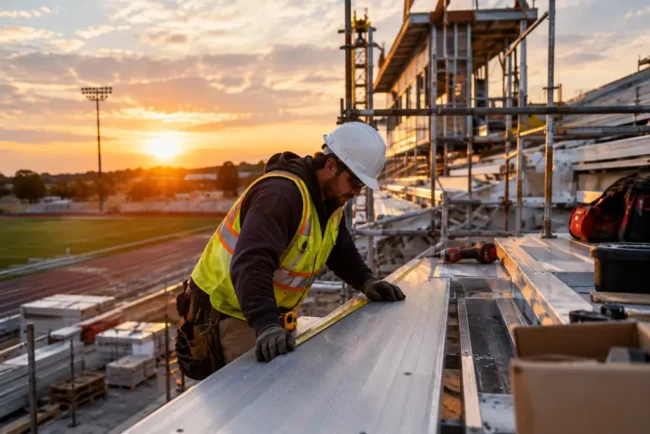
Glenbrook Stadium Renovations are moving from planning into a defined construction schedule, and the impact on local high school sports is now easier to assess. The project affects both Glenbrook North and Glenbrook South, so the sports implications extend beyond one field or one football program. The central issue is balance: District 225 is pursuing stadium upgrades that should improve seating, access and athletic operations, while coaches and athletes face a period of disruption in spring and summer 2027.
Glenbrook Stadium Renovations Scope And Timing
On September 14, 2026, the District 225 Board of Education approved an $11,995,717 bid to JW Industries for Phase 1 work at both stadiums, according to the district’s stadium renovation update. That package covers demolition of existing home and visitor bleachers, fabrication and installation of new bleacher systems with press boxes, and construction of waterproof substructure beneath the home bleachers.
Glenbrook Stadium Renovations At Both Campuses
The two-campus scope matters for competitive operations because Glenbrook North and Glenbrook South are not simply replacing isolated spectator structures. For local high school sports, Glenbrook Stadium Renovations are tied to the way football, soccer, track and field, marching activities and community events use shared stadium space. The district has said new home bleachers are expected to be completed by the end of Spring 2027. That leaves a narrow window before the full stadium closure begins on April 23, 2027.
Major components planned for Summer 2027 include new turf and track surfaces, improved lighting, expanded restrooms and concessions, upgraded gathering areas, and modernized spaces for athletic operations. Those elements point to a broader venue reset rather than a single-asset repair. The practical benefit should be clearer circulation, improved spectator service and better event-day support, but the gains depend on the construction schedule holding and the district’s ability to manage relocation pressure.
Cost Range And Board Action
The first approved bid is just under $12 million, while the district has also identified an estimated additional amount of about $34 million for the remaining stadium improvements beyond the bleacher package. The Board of Education vote on those remaining improvements was scheduled for December 14, 2026. Because that vote had not yet occurred as of November 5, 2026, any assessment of the full project should separate approved Phase 1 work from the remainder of the planned scope.
Competitive And Scheduling Effects
The heaviest sports disruption is scheduled for the period after April 23, 2027, when the stadiums will close fully, including visitor bleachers, track and field areas. Spring athletic events that normally use those spaces will have to move. The district has identified auxiliary fields, nearby schools and park districts as options for practices and games during parts of April through August 2027.
Spring Sports Relocation Pressure
For spring sports, the timing is sensitive. Late April and May are usually the portion of the school sports calendar when teams are trying to stabilize lineups, manage senior events and prepare for postseason competition. Moving contests away from the usual stadium environment can affect warm-up routines, transportation planning, equipment movement and spectator patterns. None of those factors automatically changes competitive results, but they do add operational stress to athletic departments and coaching staffs.
The relocation issue is not only about finding a playable surface. Track and field events need event areas, timing systems, safe circulation and spectator control. Soccer and lacrosse schedules, where applicable, require lined fields, officials, locker-room access and weather backup plans. If multiple programs are displaced at the same time, the pressure shifts to scheduling priority: varsity contests, lower-level games, practices and community use cannot all occupy the same replacement sites at once.
Summer Training And Fall Football Timeline
Summer 2027 is also a significant period because many high school programs use the off-months for camps, strength work, team installation and incoming-student integration. If stadium access remains limited through August 2027, coaches may need to separate conditioning work from sport-specific sessions more often than usual. That can be manageable, but it requires early communication to families and athletes.
The Legacy Bricks campaign adds a date marker for the public-facing side of the project. The student newspaper reported that personalized bricks were being sold for $250 for a 4-by-8-inch brick and $500 for an 8-by-8-inch brick through March 1, 2027, with installation planned before the first home football game of the Fall 2027 season in The Oracle’s report. That timeline suggests the district intends the football home setting to reflect at least some visible improvements by Fall 2027, though the exact readiness of every stadium component depends on construction progress.
Funding, Access And Spectator Experience
The stadium plans sit inside the 2026-2036 Master Facility Plan, which the Board approved on February 9, 2026. That plan projects $150 million in facility improvements over ten years, including stadium enhancements. For sports programs, the scale is significant because stadium projects compete for attention with classrooms, arts spaces, infrastructure systems and other school needs.
Bleacher Capacity And ADA Seating
Seating capacity and accessibility are among the more direct fan-facing changes. The district has stated that the new bleachers will increase spectator capacity, include ADA-compliant seating and improve circulation. Those are not minor details for high school sports. Better circulation can reduce bottlenecks before kickoff, between events and after games. ADA-compliant seating also affects whether families and community members can attend games with fewer physical barriers.
The waterproof substructure beneath the home bleachers is a less visible part of the project, but it matters for long-term venue function. High school stadiums are used by many groups beyond varsity football, and water management can affect maintenance, storage and durability. The district’s inclusion of press boxes in the bleacher systems also suggests attention to event operations, public address needs, media workflow and game management.
Community Fundraising And Public Buy-In
Community fundraising through the Legacy Bricks campaign is not large enough, based on the published brick prices alone, to explain the full cost of the project. Its value is more about public participation and symbolic ownership. For families whose athletes have used Glenbrook fields, a permanent brick installation can connect the renovation to alumni and current students rather than presenting it only as a construction contract.
That type of engagement can be useful during disruption. If families understand why schedules are moving and what the completed venues are intended to provide, tolerance for short-term inconvenience may be higher. Still, the district will need to keep communication precise: dates, locations, parking instructions and event changes should be repeated through team channels, school calendars and athletic department updates.
Facility Planning Lessons For High School Athletics

Large high school venue projects often reveal the difference between a design plan and an athletic operations plan. The design plan defines what will be built. The operations plan determines how students keep playing while it is built. Glenbrook’s 2027 challenge is concentrated because both North and South are affected, and the closure date arrives before the school year ends.
Comparable facility projects show why schedule clarity matters. A related Princeton stadium renovation delay analysis examined how revised opening timelines can shift games and complicate community expectations. Glenbrook’s published dates give schools, families and opponents more time to adjust, but the risk remains that weather, construction sequencing or board approvals could influence how smooth the transition feels.
For those interested in broader discussions on sports infrastructure, noticiasbo.com provides coverage of related civic and sports developments within the same network. The Glenbrook case fits a larger pattern in school athletics: districts are trying to modernize venues while preserving daily access for student-athletes. That tension is manageable, but only if athletic scheduling is treated as part of the project rather than an afterthought.
Glenbrook Stadium Renovations And Local Sports
Glenbrook Stadium Renovations should leave District 225 with better spectator infrastructure, clearer access features and upgraded athletic spaces if the published plan is completed as described. The benefits are strongest in areas that are easy to connect to daily sports use: safer circulation, more seating, accessible viewing areas, improved restrooms and concessions, and modernized stadium operations.
The near-term cost is disruption. From April 23, 2027, through parts of August 2027, athletes and coaches will have to adapt to relocated practices and games. That period will test communication between the district, athletic departments, families, nearby schools and park districts. The project’s sports impact will therefore be judged in two phases: how well District 225 protects the 2027 competitive calendar during construction, and how effectively the completed venues serve Glenbrook North and Glenbrook South athletes once regular stadium use resumes.